
Most people don’t lose their goals because they lack ability.
They lose them because they misread the moment they are in.
There is a stage in every meaningful pursuit where progress is real, effort is being invested, and growth is happening, yet results are still invisible.
To the outside eye, it looks like nothing is changing, but beneath the surface, something important is taking shape.
Many people interpret this stage incorrectly. They assume slow results mean failure, that progress should be faster, or that they are falling behind. In reality, the opposite is often true.
One of the biggest misconceptions about success is that progress should be steady and predictable. We imagine a straight line: work hard this week and see improvement next week. But real progress rarely behaves this way. It often looks flat for a long time, then suddenly rises.
Long stretches of effort. Minimal visible change. Then unexpected momentum.
This pattern shows up everywhere: in skill development, business, creative work, fitness, and personal growth. Once you recognize it, slow progress stops feeling discouraging, plateaus stop feeling permanent, and moments that once felt like failure start to look like part of the process.
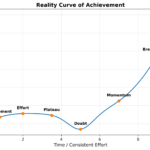
This is the Reality Curve of Achievement. Understanding it can completely change how you interpret the difficult middle of any goal.
Because most breakthroughs do not happen when people expect them.
They happen right after the stage when most people would have stopped.
The Reality Curve of Achievement
Most meaningful goals move through six predictable stages:
Excitement
Effort
Plateau
Doubt
Momentum
Breakthrough
Almost everyone begins this journey.
But far fewer people experience the later stages. This is not because they lack talent, intelligence, or discipline.
They simply misunderstand where they are on the curve.
So they walk away while progress is still forming.
To truly understand how achievement unfolds, we need to look closely at each stage of this curve.
Stage One: Excitement
Every meaningful goal begins with inspiration.
An idea appears and suddenly the future feels full of possibility. You imagine the transformation ahead. Motivation is high and the work feels exciting.
You might decide to start a business, launch a YouTube channel, write a book, or transform your health.
At this stage, everything feels fresh and promising.
But there is one important detail: you have not yet encountered the full resistance of reality.
Excitement starts the journey, but it cannot carry it all the way.
Stage Two: Effort
Soon after excitement comes effort.
You begin doing the work. You show up consistently and start building the habit.
If your goal is fitness, you start exercising regularly.
If your goal is writing, you sit down and produce words each day.
If your goal is building an audience, you publish content and share ideas.
Early improvements may appear quickly. Beginners often experience small wins that feel encouraging.
But eventually the easy progress fades, and the journey enters a quieter phase.
Stage Three: The Plateau of Latent Potential
This is where the experience becomes confusing.
You continue working, but visible progress slows down. The effort remains, yet the results seem to stall.
Many people interpret this moment as failure.
But what is actually happening is something very different.
Growth is still occurring. It is simply happening beneath the surface.
Skills are improving. Systems are forming. Experience is accumulating.
Think of it like heating water on a stove. The temperature rises steadily from thirty degrees to ninety degrees, but nothing dramatic appears to change. Only when the water reaches boiling point does the transformation become visible.
The heat was working the entire time.
In the same way, the plateau is often a period of invisible preparation.
Stage Four: The Valley of Doubt
If the plateau continues long enough, a new emotional phase appears.
Doubt.
The mind begins asking difficult questions. Is this really working? Am I wasting my time? Maybe I am not talented enough. Maybe I chose the wrong goal.
This is the most dangerous stage of the journey, because belief begins to weaken.
Many people abandon their goals here, assuming their efforts have led nowhere.
But the truth is often the opposite.
They are standing very close to momentum.
Stage Five: Momentum
For those who continue despite doubt, something interesting begins to happen.
The work starts producing results more efficiently.
Skills feel smoother. Opportunities appear more frequently. Systems begin working with less effort.
The process that once felt heavy begins moving with greater ease.
Imagine pushing a massive metal flywheel. At first it barely moves. Each push feels difficult and slow.
But if you continue long enough, the wheel begins turning on its own momentum. Every additional push becomes easier.
Momentum changes everything.
Stage Six: Breakthrough
Eventually the invisible effort becomes visible success.
The business begins growing quickly. The audience expands. The transformation becomes obvious to others.
From the outside, this moment often looks like overnight success.
But the person who experienced it knows the truth.
The breakthrough was built through months or years of consistent effort that came before.
Just like the final drop that causes a glass to overflow, the breakthrough is the visible result of countless small actions that accumulated quietly over time.
Why Most People Quit Too Early
The difficult truth is that most people leave the journey during the plateau or the valley of doubt.
They expect progress to move in a straight line. When the line flattens, they assume the process has failed.
In reality, they are simply inside the invisible phase of achievement.
If you want to truly benefit from the reality curve of achievement, you must also understand the psychological traps that appear during this invisible phase of the journey.
They are the reason most people exit the curve before momentum arrives.
They are essentially mental illusions. When people do not recognize them, they misinterpret their situation and assume something is wrong. As a result, they quit too early.
Three Psychological Traps That Appear During the Plateau
1. The Linear Progress Illusion
Humans naturally expect progress to look like a straight line.
Effort today should produce visible improvement tomorrow. Work harder, get better results. Simple.
But real achievement rarely works this way.
In reality, progress often looks like a long flat period followed by a sudden jump. When people expect steady improvement but instead experience a plateau, they assume their efforts are not working.
Consider someone starting a YouTube channel. They imagine their growth will look something like this: ten views, then fifty views, then two hundred, then a thousand.
But the real pattern is often much messier. The numbers might bounce around for a long time: 10 views, 12 views, 9 views, 14 views, 11 views, 13 views. Then suddenly one video receives 1,000 views.
The jump appears sudden, but it was quietly building through practice, experimentation, and algorithm learning.
A good metaphor is heating water. As the temperature rises, nothing dramatic appears to change. Only when the water reaches boiling point does the transformation become visible.
Yet the heat was working the entire time.
In the same way, progress is often happening even when results are not yet visible.
2. The Comparison Trap
During the plateau, people often start looking sideways.
They notice others who seem to be progressing faster, which creates feelings of discouragement, inadequacy, and impatience.
But comparison is deeply misleading because we rarely see the full timeline of another person’s journey.
What looks like quick success often hides years of preparation.
For example, a new writer might see someone whose book suddenly becomes popular and assume that the success happened quickly.
But the author may have spent ten years writing, revising multiple failed drafts, and slowly building an audience before that moment arrived.
Comparison compresses other people’s timelines while exaggerating our own struggles.
It is like watching the final scene of a movie without seeing the first hour. You witness the victory but not the preparation that made it possible.
Comparison hides the invisible years behind other people’s breakthroughs.
3. The Effort-Result Mismatch
This is often the most emotionally difficult trap.
The human mind expects effort and reward to feel balanced. If someone works hard for several months, they naturally expect noticeable progress during that time.
But in many areas of life, effort and results are asymmetrical.
Long periods of intense work may produce only small visible rewards. Then suddenly, a relatively small action produces a very large outcome.
This imbalance can feel unfair. But it is simply how compounding works.
For example, a content creator may post videos for months with very little attention. Then one video suddenly reaches a large audience.
To outsiders, it looks like luck.
But that video was only possible because of the months of practice and experimentation that came before it.
Think of mining for gold. A miner may dig for days without finding anything valuable. Then one strike finally hits the vein.
All the digging that seemed unproductive was actually necessary to reach that discovery.
The effort that appears wasted is often the effort that makes the breakthrough possible.
Why These Traps Are Dangerous
These psychological traps are particularly dangerous because they appear during the exact phase when persistence matters most.
The plateau is the stage where people must continue working. Yet the mind interprets the lack of visible progress as evidence of failure.
So people quit right before momentum begins.
The Great Filtering Effect
This creates something fascinating.
The plateau acts as a natural filter.
People who expect quick rewards tend to leave early. People who understand the process stay in the game.
Over time, the second group is far more likely to experience breakthroughs.
This is why success often has less to do with talent than people assume. Many successful individuals are not necessarily more gifted than others.
They simply stayed in the curve longer.
The plateau is not where success stops.
It is where success is quietly forming.
Something to Leave You With
Most people abandon their goals during the most important phase of the journey.
During the phase when success is still forming beneath the surface.
They look around, see no obvious results, and assume nothing is happening. So they walk away, never realizing that the process was silently working beneath the surface the entire time.
But the truth is this:
The invisible phase is not the absence of progress.
It is the construction phase of progress.
It is where skills are sharpening, systems are forming, and momentum is slowly gathering force.
So if you ever find yourself working hard while the results seem minimal, resist the urge to panic.
You may not be failing.
You may simply be inside the curve.
And the curve has a remarkable pattern: it stays flat longer than you expect… and then it rises faster than you imagined.
Which leads to a powerful mental reframe you can carry with you whenever progress feels slow.
Instead of thinking:
“Nothing is happening.”
Tell yourself:
“I am in the construction phase.”
Because long before success becomes visible, it is silently being built.
And for those who stay in the process long enough, the curve always turns upward.
Sources and Adaptation:
The Reality Curve of Achievement is adapted from principles in Malcolm Gladwell’s Outliers, James Clear’s Atomic Habits, and research on deliberate practice. Diagram and framing by Cynthia Angella Murungi.
If you enjoy my work and would like to show some love, I’d truly appreciate it. Thank you!
https://selar.com/showlove/cynthiamurungi

- Hey there! Welcome to thehealseekers, a space dedicated to helping women explore metaphysics, psychology, and self-development as tools for clarity, purpose, and goal achievement. I hope you find inspiration here.
Latest Post
 Self-developmentMarch 9, 2026The Reality Curve of Achievement: Why Success Feels Slow Before It Feels Sudden
 MetaphysicsMarch 6, 2026The Levels of Consciousness That Shape Your Life: Why Awareness Determines the Quality of Your Decisions and Your Destiny
 Self-developmentMarch 3, 2026Friction Theory: The Hidden Reason Your Goals Feel Harder Than They Need to Be
 Self-developmentMarch 2, 2026Sustainable Success Requires Alignment: Why Effort Alone Is Not Enough